

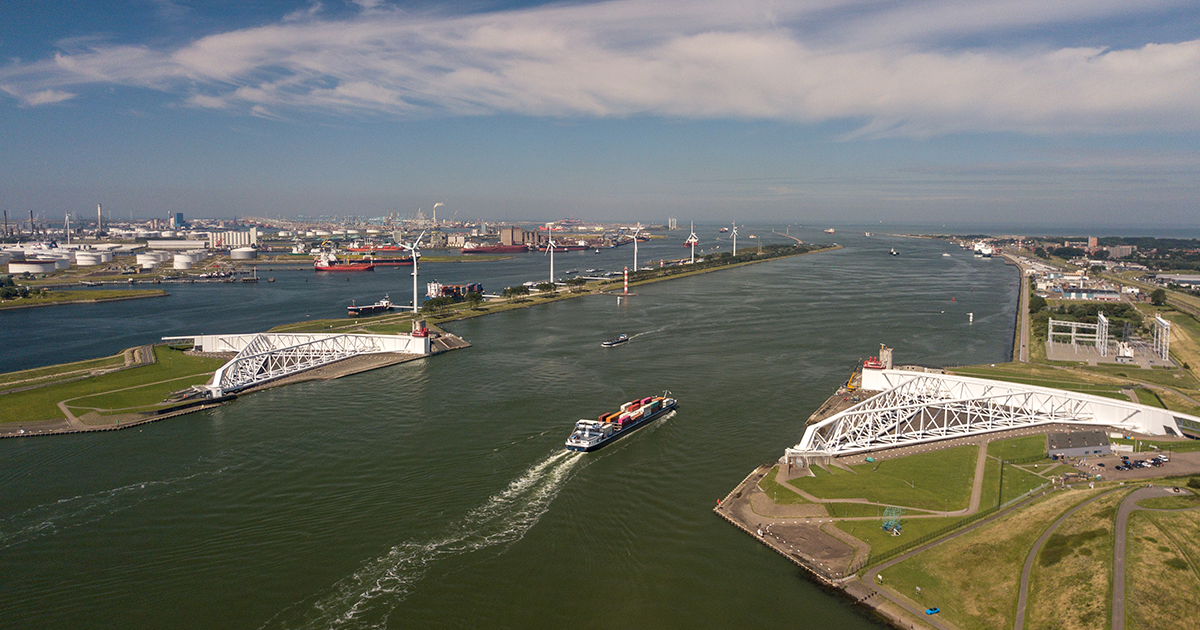
In my last post, I compared the Dutch bet on prevention with the American bet on response. This time I want to write about the single most astonishing piece of prevention I have ever seen: the Maeslant Barrier (Maeslantkering), the giant storm-surge gate that guards Rotterdam. I have spent my career around levees, weirs, and bypasses. Nothing prepared me for standing next to this.
How It Came to Be
After the 1953 flood, the Dutch launched the Delta Works, a generation-long program of dams, barriers, and raised dikes (levees). By the 1980s, one major gap remained: the Nieuwe Waterweg, the shipping channel that connects the Port of Rotterdam to the North Sea. You cannot simply dam the main entrance to Europe’s busiest port. So the Dutch needed a barrier that would stand wide open almost all the time, then close completely when the sea turned dangerous.
The answer was the Maeslant Barrier. It was built as part of the Europoort Barrier project, the final stage of the Delta Works. It was also among the first large Dutch “design and construct” projects, in which the winning contractor designed the structure as well as built it. Construction began in 1991 and took six years. Queen Beatrix opened the barrier on May 10, 1997.
A Sense of Scale
The numbers are hard to absorb:
- The gates. There are two, each 210 meters (about 690 feet) long and 22 meters (about 72 feet) high.
- The arms. Steel trusses 237 meters (about 780 feet) long hold the gates. Stood on end, each arm would be as tall as the Eiffel Tower, and each weighs about 6,800 tonnes.
- The joints. Each arm pivots on a ball-and-socket joint 10 meters (about 33 feet) in diameter and weighing 680 tonnes. It is the largest such joint in the world, built at the Škoda Works in the Czech Republic.
- Coverage and cost. Closed, the barrier spans the full 360-meter (roughly 1,180-foot) width of the waterway. It cost €450 million to build.
It is one of the largest moving structures on Earth. The two gates normally sit in dry docks on either bank. To close the barrier, the docks are flooded so the hollow gates float. The gates are then swung into the channel, filled with water, and sunk onto a sill on the river bottom.
The barrier also runs itself. A computer closes it automatically when the water is forecast to exceed 3 meters (about 10 feet) above NAP (the Dutch reference sea level) at Rotterdam. Rijkswaterstaat (kind of the Dutch Army Corps of Engineers) keeps a team of experts on hand to watch and intervene if needed. Together with the nearby Hartel Barrier, it protects roughly 2 million people in Rotterdam, Dordrecht, and the surrounding area.
What They’ve Learned Since
Being one of a kind is a point of pride. Our hosts were also refreshingly direct about its costs. Two lessons stood out.
One-of-a-kind parts. According to our hosts, the gates are moved by 12 engines, six on each side, and those engines are unique. There is no catalog to order a replacement from. When one needs replacing, it has to be custom-built. The same problem runs through the whole structure. The world has very few storm-surge barriers, so the people who manage them have formed an international network, I-STORM, to share their scarce knowledge and experience. The members include the managers of London’s Thames Barrier and Venice’s MOSE system.
The single gate on the dry dock. Each gate rests in its dry dock when it isn’t in use, which protects it from the corrosion of constant immersion. But when the dock itself needs maintenance, there is no way to isolate the work. The dock has to be flooded, and the gate sits in the water. Our hosts told us that a double gate on the dock would have avoided this. It is a small design choice with a long-lasting maintenance cost.
Neither lesson takes anything away from the achievement. Both are the kind of hard-won knowledge every agency that builds large, unique infrastructure should take to heart. Design for the day something breaks, and design for the day you need to fix it.
A Barrier Built for One Climate, Operating in Another
The barrier was designed to close rarely. Our hosts told us the original expectation was one closure every five to ten years. So far, that has roughly held. The barrier closed during storms in 2007 and 2018, but it wasn’t until Storm Pia in December 2023 that the water actually reached the level that triggers an automatic closure.
That is about to change. Our hosts told us that with climate change, the barrier is expected to close about once a year on average. With 1.4 meters (about 4.6 feet) of sea level rise, it could need to close 30 times a year. The Dutch government’s sea level rise research program, completed this June, reached a similar conclusion: the country’s storm-surge barriers will need to close more and more often this century. It also expects the Maeslant Barrier to need replacement sometime between 2070 and 2100, simply because it will reach the end of its service life. Every closure halts shipping to the port and affects the tidal ecosystem. So one option under discussion is to raise the water level at which the barrier closes, which would limit how often it closes.
A structure designed to move once a decade will never be the same structure if it moves thirty times a year. The engines, the joints, the maintenance schedule, and the docks were all sized for a rare event. That is the real climate lesson here. It isn’t only about how high the water gets. It is about how often we ask our infrastructure to perform.
A Nation of Engineers
Our hosts described the Netherlands as a nation of engineers, and they meant it literally. With so much of the country below sea level, the Dutch never had the option of walking away from flood risk. They had to engineer their way out of it, century after century. The Maeslant Barrier is the most dramatic expression of that ingenuity I have seen.
It also carries a message for those of us back home. Great infrastructure is not finished when it is built. It has to be maintained with parts someone can actually get, operated in a climate that is still changing, and eventually replaced. The Dutch are already planning for all three. We should be too.