

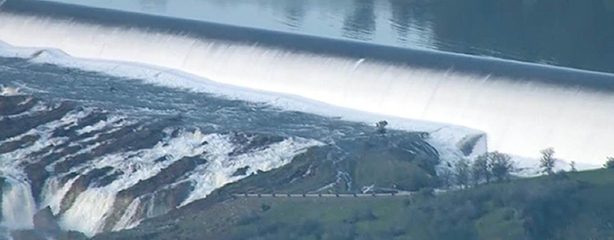
 Here is Tuesday morning’s installment of our update on the Oroville Dam spillway incident. For background, please see our earlier blog posts, starting last Thursday, February 9, and most recently our update of February 13 which sets the stage and provides context. In sum, the evacuation continues; the emergency or auxiliary spillway is stable; workers are adding rock to address the erosion that caused the evacuation; the primary or service spillway is also stable, and is currently evacuating 100,000 cfs from the reservoir; but new storms are forecasted to roll in starting Wednesday, and many people are still worried about how the reservoir and its spillways will handle the water.
Once again we have tried to share the important facts and the context, without hype, sensationalism, or blame. If you find this helpful, please feel free to share it with others who may be interested. And if you would like to be updated when we post a new entry, please add your email on the right where it says “stay connected.”
 What a difference a day makes! As of Friday afternoon, it appeared unlikely that Oroville Reservoir would rise enough for water to flow over the emergency spillway, as inflow into the lake had been declining since early Friday, the rain had stopped, and the primary spillway continued to be used to manage outflow. But the gaping hole in the spillway, coupled with concerns about downstream flooding, resulted in the story traveling all the way back to
  As many of you know, the big news on Tuesday was that the spillway on Oroville Dam had developed a large crater from water eroding away the Oroville Spillway structure. Based on the large hole, DWR stopped all flows down the Spillway to evaluate the damage. Water users downstream started to get nervous as Oroville was rising quickly, and folks feared that water could come over the emergency spillway, which would be uncontrolled.